

Book Affordable Bus Tickets to Perquín
Local buses to Perquín via San Miguel — El Salvador's mountain town in Morazán + former FMLN guerrilla stronghold + civil war history museum
Why choose Spring Bus?
Spring Bus is the best way to find bus tickets to Perquín

Plan your perfect trip
Find and book your bus tickets in just a few clicks.

Best prices
We partner with top bus companies to provide you with the best prices available.

Flexible Booking
Change your travel plans as needed with our flexible booking options.
Perquín is a small mountain town (~3,500 residents) in Morazán department in northeastern El Salvador — set at 1,140 m altitude in pine forests, with a cool mountain climate that's a welcome contrast to the country's hot lowlands. Perquín's significance is historical: it was the headquarters of the FMLN guerrilla forces during El Salvador's 1980-1992 civil war + remained outside government control for most of the conflict. Today, the town is home to the Museo de la Revolución Salvadoreña (Museum of the Salvadoran Revolution) — one of Central America's most important civil-war museums, with extensive exhibits on the conflict (crashed military helicopters, weapons, photographs, the clandestine Radio Venceremos transmitter that broadcast FMLN propaganda during the war, personal artifacts of guerrilla fighters). Nearby (~1 hour by colectivo) is the El Mozote memorial — site of the December 1981 El Mozote massacre, one of the worst civilian atrocities of the war (~800+ villagers killed by the U.S.-trained Atlacatl Battalion).
Spring Bus connects you to operators running scheduled service to Perquín. The standard route is via San Miguel — take Ruta 301 from San Salvador to San Miguel (~2.5 h, $3-5 USD), then Ruta 332 from San Miguel's eastern terminal to Perquín (~1.5 h, $2-5 USD). Total ~4 hours, $5-10 USD. Direct tourist shuttles from San Salvador are available on-demand for travelers preferring comfort (~$50-80 USD/person, pre-book). The town itself is small + walkable; most lodging is small guesthouses + the Hotel Perkin Lenca (~$30-60 USD/night, with restaurant + good civil-war library + tours).
Popular routes to Perquín
Estimated travel time, distance and shared-shuttle fare ranges for the most common routes into Perquín.
From San Miguel
- Duration
- ~1.5 h
- Distance
- 65 km
- Fare (shared shuttle)
- $2 – $5 USD
- Frequency
- Ruta 332 multiple daily
From San Salvador (via San Miguel)
- Duration
- ~4 h with transfer
- Distance
- 200 km
- Fare (shared shuttle)
- $5 – $10 USD combined
- Frequency
- Ruta 301 + Ruta 332
From El Mozote memorial
- Duration
- ~1 h
- Distance
- 30 km
- Fare (shared shuttle)
- $1 – $3 USD
- Frequency
- Local colectivos
From Joateca + Arambala (nearby civil war sites)
- Duration
- ~30 min
- Distance
- 15 km
- Fare (shared shuttle)
- $1 USD
- Frequency
- Local pickup
From Direct tourist shuttle from San Salvador
- Duration
- ~3.5 h
- Distance
- 195 km
- Fare (shared shuttle)
- $50 – $80 USD
- Frequency
- On-demand pre-booked
How to get to Perquín by bus
Perquín is reached via San Miguel (the standard public-bus route) or by direct tourist shuttle.
Via San Miguel by public bus (the standard, cheap route)
San Salvador → San Miguel on Ruta 301 (~2.5 h, $3-5 USD) or Comfort Lines (~2 h, $8-15 USD). Then San Miguel → Perquín on Ruta 332 from the eastern terminal (~1.5 h, $2-5 USD). Total ~4 hours, $5-20 USD. The standard route for budget + most travelers.
By direct tourist shuttle from San Salvador
Pre-booked tourist shuttles from San Salvador hotels run on-demand to Perquín — ~3.5 hours, $50-80 USD per person. Less frequent than the public bus route + significantly pricier; useful for travelers preferring direct comfort.
By rental car (popular for civil-war history travelers)
Self-drive from San Salvador via San Miguel + the Carretera Ruta de la Paz — ~3.5 hours direct. Rental cars from SAL airport ~$40-80 USD/day. Useful for combining multiple civil-war sites (Perquín + El Mozote + Joateca + Cinquera) over a 2-3 day trip.
About Perquín
Perquín became the headquarters of the FMLN (Frente Farabundo Martí para la Liberación Nacional) guerrilla forces during El Salvador's 1980-1992 civil war — the mountainous terrain + pine forests of northern Morazán made the area difficult for government forces to control. The FMLN's clandestine Radio Venceremos transmitter (Radio "We Will Win") broadcast from caves + mobile locations around Perquín throughout the war — providing FMLN propaganda + news to the population + counter-messaging to the government-controlled media. The town remained largely outside government control until peace accords in 1992. After the war, Perquín's Museo de la Revolución Salvadoreña opened in the early 1990s with FMLN veterans curating exhibits — crashed military helicopters in the courtyard, weapons + uniforms, photographs of the conflict, the actual Radio Venceremos transmitter, personal artifacts of guerrilla fighters. The museum is one of Central America's most important civil-war institutions + a sobering experience.
El Mozote — a small village ~30 km / 1 hour south of Perquín — is the site of the December 1981 El Mozote massacre, one of the worst civilian atrocities in modern Latin American history. The U.S.-trained Atlacatl Battalion of the Salvadoran army killed an estimated 800-1000 villagers (mostly women + children) over three days during a counter-insurgency operation. The site is now a memorial — a stark white wall listing the names of the dead, a rebuilt church, and a small museum. The massacre's existence was denied by the U.S. and Salvadoran governments for years until the 1993 UN Truth Commission documented it; survivors have only recently received any judicial acknowledgment. Visiting Perquín + El Mozote is a serious history-focused experience — not a leisure destination. Many travelers find the mountain town's pine forests + cool climate + civil-war history make Perquín one of El Salvador's most affecting + memorable visits.
Travel tips for getting to Perquín
- Hotel Perkin Lenca is the recommended overnight option — small mountain inn ($30-60 USD/night) with restaurant + civil-war library + can arrange tours to El Mozote + other sites.
- Museo de la Revolución Salvadoreña is the main reason most travelers visit — open Tuesday-Sunday, ~$3-5 USD entry, allow 2-3 hours.
- El Mozote memorial day trip (~1 hour by colectivo from Perquín) is essential for civil-war history travelers — sobering + important.
- Cool mountain climate (10-20°C most days at 1,140 m altitude) — bring warmer layers, especially evening + early morning.
- Combine 2-3 nights to see the museum + El Mozote + nearby Arambala/Joateca civil-war sites + the pine forest walks.
- Spanish-only at most sites — Museo de la Revolución has some English signage but a Spanish-speaking guide ($10-20 USD) significantly improves the experience.
Bus to Perquín — frequently asked questions
How do I get to Perquín from San Salvador?
Via San Miguel (the standard cheap route): Ruta 301 San Salvador → San Miguel (~2.5 h, $3-5 USD), then Ruta 332 San Miguel → Perquín (~1.5 h, $2-5 USD). Total ~4 hours, $5-20 USD. Direct tourist shuttle ~3.5 hours, $50-80 USD.
What's the Museo de la Revolución Salvadoreña?
One of Central America's most important civil-war museums — opened in the early 1990s by FMLN veterans in Perquín (the former FMLN guerrilla headquarters during the 1980-1992 war). Extensive exhibits include crashed military helicopters in the courtyard, weapons + uniforms, the original Radio Venceremos clandestine transmitter, photographs, and personal artifacts of guerrilla fighters. Open Tuesday-Sunday, ~$3-5 USD entry, allow 2-3 hours.
Should I visit El Mozote?
Yes if you're interested in civil-war history — the December 1981 El Mozote massacre site (~30 km / 1 hour from Perquín) is one of the most important + sobering historical sites in modern Latin America. ~800-1000 villagers killed by the U.S.-trained Atlacatl Battalion. The memorial site has a name-wall listing the dead, a rebuilt church, and a small museum. Visit takes ~2-3 hours; many travelers find it emotionally significant.
Is Perquín a leisure destination?
No — Perquín is a history-focused + eco-tourism destination, not a leisure stop. The civil-war museum + El Mozote memorial are sobering experiences, not light entertainment. The mountain pine forests + cool climate + small-town atmosphere are pleasant for nature walks + slow travel. Most travelers combine 2-3 nights here as the historical-cultural part of an El Salvador itinerary.
When is the best time to visit Perquín?
November – April (dry season) for hiking + comfortable temperatures. The mountain climate (1,140 m altitude) is cooler year-round than lowland El Salvador (10-20°C most days, can drop lower at night) — bring warmer layers regardless of season. Rainy season (May – October) brings afternoon mountain storms + can muddy hiking trails.
How long should I stay in Perquín?
2-3 nights. Day 1: arrive + walk village + Museo de la Revolución. Day 2: El Mozote memorial day trip + smaller civil-war sites (Arambala, Joateca). Day 3: nature walks in the pine forests + onward. Can be done in 1 overnight if you only want the museum + a quick El Mozote visit, but 2-3 nights lets you absorb the history at a meaningful pace.
Other destinations in El Salvador
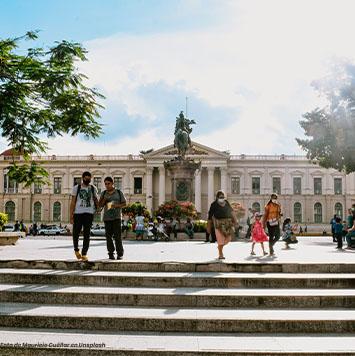 Destination
San Salvador
San Salvador department
El Salvador's capital and the country's main entry point — international airport (SAL) ~45 minutes south, ringed by volcanoes (San Salvador, Boquerón crater), modern districts (Escalón, Zona Rosa) for upscale stays. The transit hub for El Tunco surf, Suchitoto colonial, Santa Ana volcano, and cross-border service to Guatemala and Honduras.
DestinationEl Tunco
La Libertad (Pacific coast)
El Salvador's most popular surf village, ~45 minutes from San Salvador along the Pacific coast. Consistent year-round waves (best April–October), iconic Roca Sunzal rock formation, walkable village of hostels and beachfront bars, the standard backpacker base for the Pacific coast.
DestinationEl Zonte
La Libertad (Pacific coast)
Quieter surf village ~20 minutes west of El Tunco on El Salvador's Pacific coast, known globally as "Bitcoin Beach" since the 2019 community experiment that helped inspire El Salvador's 2021 Bitcoin Legal Tender Law. Consistent surf, mellower vibe than El Tunco.