

Book Affordable Bus Tickets to Jinotega
Local buses to Jinotega — Nicaragua's "City of Mists" + premium coffee region in the north central highlands + Lake Apanás
Why choose Spring Bus?
Spring Bus is the best way to find bus tickets to Jinotega

Plan your perfect trip
Find and book your bus tickets in just a few clicks.

Best prices
We partner with top bus companies to provide you with the best prices available.

Flexible Booking
Change your travel plans as needed with our flexible booking options.
Jinotega is Nicaragua's "City of Mists" (Ciudad de las Brumas) + the country's second major coffee region after Matagalpa — set at 1,000 m altitude in the north central highlands, ~1 hour north of Matagalpa on a winding mountain road. The town's nickname comes from the near-daily morning fog rolling over the surrounding mountains — a result of the high altitude + dense forest cover. The cool, perpetually misty climate is ideal for premium coffee + cardamom + vegetable production, making the region one of Nicaragua's most agriculturally productive areas. The town itself (~40,000 residents) is smaller + more authentic than nearby Matagalpa, with a small colonial center anchored by the Catedral San Juan de Jinotega (the city's signature landmark with its distinctive blue domes).
Spring Bus connects you to operators running scheduled service: local buses from Matagalpa (~1 hour, C$30-60 / US$1-3 USD) + direct buses from Managua (~3.5-4 hours via Sébaco + Matagalpa, $5-10 USD). The town is small + walkable — most travelers come for the coffee culture, the cool climate, and access to nearby nature. Coffee farm tours are available through Jinotega-based cooperatives (especially the Soppexcca + Sacaclí cooperatives — small-farmer collectives producing specialty + fair-trade coffee). Lake Apanás (~5 km north of town — Nicaragua's largest artificial reservoir, built in 1964 for hydroelectric power) is popular for fishing + birdwatching + boat trips. Cerro La Bandera (the town's highest viewpoint) offers panoramic mountain + lake views.
Popular routes to Jinotega
Estimated travel time, distance and shared-shuttle fare ranges for the most common routes into Jinotega.
From Matagalpa
- Duration
- ~1 h
- Distance
- 35 km
- Fare (shared shuttle)
- C$30 – $60 / US$1-3 local bus
- Frequency
- Local buses every 30-60 min
From Managua (via Matagalpa + Sébaco)
- Duration
- ~3.5-4 h
- Distance
- 165 km
- Fare (shared shuttle)
- $5 – $10 USD combined
- Frequency
- Local buses + transfer
From Estelí (highland combo)
- Duration
- ~2.5-3 h via San Rafael del Norte
- Distance
- 110 km
- Fare (shared shuttle)
- $5 – $10 USD
- Frequency
- Daily local buses
From Lake Apanás (Nicaragua's largest artificial lake)
- Duration
- ~10-15 min
- Distance
- 5 km north
- Fare (shared shuttle)
- $3 – $7 USD taxi / boat trips $20-40 USD
- Frequency
- Year-round
From Coffee farm tours (Soppexcca + Sacaclí cooperatives)
- Duration
- ~30-60 min
- Distance
- 10-30 km
- Fare (shared shuttle)
- $20 – $50 USD/person
- Frequency
- Daily tours from Jinotega hotels
Routes from Jinotega
Direct bus and shuttle service leaving Jinotega for other destinations in Nicaragua — tap any route for travel time, fares, operators, and FAQs.
How to get to Jinotega by bus
Jinotega is reached by local bus from Matagalpa or Managua via the central highlands — the standard route.
By local bus from Matagalpa (the standard)
Local buses from Matagalpa to Jinotega — ~1 hour, C$30-60 / US$1-3, every 30-60 minutes during daytime. The winding mountain road climbs from Matagalpa's 680 m altitude to Jinotega's 1,000 m, with dramatic green-mountain views.
By local bus from Managua
Local buses from Managua's Mercado Mayoreo terminal via Sébaco + Matagalpa — ~3.5-4 hours total, $5-10 USD. Most travelers transfer at Matagalpa.
From Estelí (highland combo)
Local buses from Estelí via San Rafael del Norte — ~2.5-3 hours, $5-10 USD. Less common route but works for travelers combining the northern highlands region.
About Jinotega
Jinotega's modern history is shaped by coffee + by the Sandinista revolution. Coffee cultivation began here in the early 1900s + grew rapidly in the mid-1900s as the cool mountain climate proved ideal for high-altitude arabica varieties. The region produces some of Nicaragua's most prestigious specialty coffees — particularly through small-farmer cooperatives like Soppexcca (a fair-trade collective representing ~700 small farmers) + Sacaclí. These cooperatives often offer farm tours that prioritize the social/economic story (small-farmer livelihoods, fair-trade pricing, cooperative organization) alongside the bean-to-cup process — often more meaningful than the larger commercial-farm tours.
The town's Catedral San Juan de Jinotega (the city's signature landmark with its distinctive blue domes, visible from across the surrounding valley) anchors the small colonial center. Beyond coffee, the area's main attractions are nature-focused: Lake Apanás (~5 km north — Nicaragua's largest artificial reservoir, built in 1964 to power the country's largest hydroelectric plant + now a popular fishing + birdwatching + boat-trip destination), Cerro La Bandera (the town's highest viewpoint with panoramic mountain + lake views), and Datanlí-El Diablo natural reserve (cloud forest ~15 km away with hiking + waterfalls). Jinotega is less touristy than Matagalpa + offers a more authentic small-Nicaraguan-town experience — fewer English speakers, more basic infrastructure, but a stronger sense of local life + community.
Travel tips for getting to Jinotega
- Coffee cooperative tours (Soppexcca, Sacaclí) prioritize the small-farmer + fair-trade story — often more meaningful than larger commercial farm tours.
- Cool + misty climate at 1,000 m altitude — bring layers + light rain jacket year-round.
- Catedral San Juan de Jinotega with distinctive blue domes is the town's signature landmark.
- Lake Apanás boat trip + fishing — Nicaragua's largest artificial lake, ~5 km north.
- Cerro La Bandera for panoramic mountain + lake views (short hike).
- Combine with Matagalpa (1 h south) for full central highlands coffee region — 4-5 night itinerary.
- Less touristy + more authentic than Matagalpa — fewer English speakers, basic infrastructure but stronger local life.
Bus to Jinotega — frequently asked questions
How do I get to Jinotega from Matagalpa?
Local buses every 30-60 minutes — ~1 hour, C$30-60 / US$1-3 per person. The winding mountain road has dramatic green-mountain views.
Why is Jinotega called "City of Mists"?
Ciudad de las Brumas — the town's near-daily morning fog rolling over the surrounding mountains, a result of the high altitude (1,000 m) + dense forest cover + cool climate. The mists usually burn off by midday, leaving warm afternoons + cool evenings.
Jinotega or Matagalpa — which coffee region?
Both are excellent for coffee + cool mountains. Jinotega is smaller, higher altitude (1,000 m vs 680 m), more authentic + less touristy, with cooperative-based small-farmer tours. Matagalpa is larger, more developed tourism (Selva Negra eco-lodge), more English speakers. Many travelers visit both — they're 1 hour apart.
What's Lake Apanás?
Nicaragua's largest artificial lake — built in 1964 to power the country's largest hydroelectric plant. ~5 km north of Jinotega. Popular for fishing (tilapia, guapote), birdwatching (kingfishers, herons, raptors), and boat trips ($20-40 USD/person for ~2-hour tours).
Can I do a coffee tour from Jinotega?
Yes — through Soppexcca + Sacaclí cooperatives ($20-50 USD/person tours). These small-farmer collective tours prioritize the social/economic story (fair-trade pricing, small-farmer livelihoods, cooperative organization) alongside the bean-to-cup process — often more meaningful than commercial farm tours.
How long should I stay in Jinotega?
1-2 nights as a Matagalpa extension, 2-3 nights for proper coffee + lake + hiking immersion. Combines well with Matagalpa (1 h south) for a 4-5 night central highlands trip.
Other destinations in Nicaragua
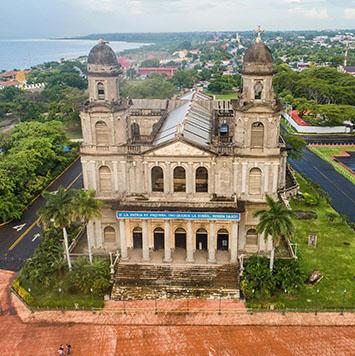 Destination
Managua
Managua department
Nicaragua's capital, less touristy than Granada or León but the main international gateway via Augusto C. Sandino International Airport (MGA). Most travelers transit through to Granada (~45 min) or León (~2 h). Unusual decentralized layout (no traditional downtown) because of the 1972 earthquake. La Costeña flights to the Corn Islands depart from here.
DestinationGranada
Granada (Lake Nicaragua)
Nicaragua's most-visited colonial city, founded in 1524 and one of the oldest Spanish-built cities in mainland Americas. Sits on the shores of Lake Nicaragua at the base of Mombacho Volcano, ~45 minutes from Managua. Famous colorful colonial center around the Cathedral and Calle La Calzada, boat trips through Las Isletas, and a strong Spanish-school scene.
DestinationLeón
León
Nicaragua's revolutionary university city ~2 hours from Managua, famous for the UNESCO-listed Cathedral of León (the largest in Central America), revolutionary Sandinista murals across the city, and the famous Cerro Negro volcano boarding adventure (sliding down an active volcano on a wooden board). More authentic and less polished than colonial rival Granada.