

Book Affordable Bus Tickets to Palomino
Hammocks, river tubing and surf where the Sierra Nevada meets the Caribbean.
Why choose Spring Bus?
Spring Bus is the best way to find bus tickets to Palomino

Plan your perfect trip
Find and book your bus tickets in just a few clicks.

Best prices
We partner with top bus companies to provide you with the best prices available.

Flexible Booking
Change your travel plans as needed with our flexible booking options.
Palomino is a small fishing-turned-backpacker village on the Troncal del Caribe in southwestern La Guajira, set on a wide golden beach where rivers fed by the Sierra Nevada de Santa Marta run down to the sea. Travelers come for the laid-back rhythm: floating downriver on inner tubes, swinging in beachfront hammocks, learning to surf and watching the mountains glow at sunset. It is one of the Caribbean coast's most beloved budget destinations, attracting an international crowd of independent travelers. Spring Bus connects you to operators running the coastal route, with realistic fares from around $4 to $10 USD for the short hop from Santa Marta.
Getting to Palomino by bus is simple because every vehicle heading east toward Riohacha passes right through the village on the main highway. From Santa Marta the trip takes about 1.5 to 2 hours covering roughly 75 km. Local intermunicipal buses, Expreso Brasilia coaches and shared colectivos all stop on the Troncal del Caribe at the village entrance, where motorcycle taxis ferry you the last stretch down the sandy track to the beach. From Palomino you can continue east to Riohacha as a gateway to the Wayuu desert, or backtrack west toward Tayrona National Park and Santa Marta.
Popular routes to Palomino
Estimated travel time, distance and shared-shuttle fare ranges for the most common routes into Palomino.
From Santa Marta
- Duration
- ~1.5–2h
- Distance
- 75 km
- Fare (shared shuttle)
- $4–$10 USD
- Frequency
- Frequent (Brasilia/colectivos)
From Riohacha
- Duration
- ~1.5h
- Distance
- 95 km
- Fare (shared shuttle)
- $5–$11 USD
- Frequency
- Frequent (Brasilia)
From Tayrona (El Zaino)
- Duration
- ~45min
- Distance
- 40 km
- Fare (shared shuttle)
- $3–$7 USD
- Frequency
- Frequent (colectivos)
From Cartagena
- Duration
- ~5–6h
- Distance
- 300 km
- Fare (shared shuttle)
- $20–$32 USD
- Frequency
- Daily (Brasilia, via Santa Marta)
From Barranquilla
- Duration
- ~3.5h
- Distance
- 190 km
- Fare (shared shuttle)
- $16–$26 USD
- Frequency
- Several daily (Brasilia)
Routes from Palomino
Direct bus and shuttle service leaving Palomino for other destinations in Colombia — tap any route for travel time, fares, operators, and FAQs.
How to get to Palomino by bus
Palomino sits directly on the Troncal del Caribe, the coastal highway linking Santa Marta and Riohacha, so any eastbound bus drops you at the village entrance. The last few hundred meters to the beach are covered by motorcycle taxi.
By bus from Santa Marta
The standard route is the 1.5 to 2-hour trip from Santa Marta, around 75 km east along the Troncal del Caribe. Expreso Brasilia coaches and shared minivan colectivos leave throughout the day from the Santa Marta market area and the main terminal, with fares as low as $4 to $10 USD. Tell the driver you are getting off in Palomino and they will stop at the village entrance on the highway. From there, mototaxis charge a small fee to take you down the sandy lane to the beachfront hostels. Buses pass roughly every 30 to 60 minutes during the day, so you rarely wait long in either direction.
By bus from Riohacha
Coming from the east, Palomino is about 1.5 hours and 95 km from Riohacha, the capital of La Guajira. Expreso Brasilia runs the route frequently, and any Santa Marta-bound bus will let you off at the village. Fares run around $5 to $11 USD. This makes Palomino an easy stop when traveling between the Wayuu desert region and Tayrona or Santa Marta, letting you break a longer coastal journey with a few relaxed beach days.
By colectivo from Tayrona
If you are coming from Tayrona National Park, the El Zaino entrance is only about 40 km and 45 minutes west of Palomino. Frequent colectivos and buses on the highway connect the two for roughly $3 to $7 USD, making it easy to combine a day of jungle-fringed beaches in Tayrona with a stay in Palomino. Flag down any eastbound vehicle from the roadside.
About Palomino
Palomino's appeal lies in a rare geographic coincidence: the Sierra Nevada de Santa Marta, the world's highest coastal mountain range with snow-capped peaks rising over 5,700 meters, sits just a few kilometers inland from a warm Caribbean beach. Rivers born in the high sierra rush down through tropical forest to the sea, and the village's signature activity is river tubing down the Río Palomino, drifting for an hour or two beneath the trees before reaching the river mouth. The beach itself is long, wide and undeveloped, lined with palm-thatched hostels and rustic eco-lodges rather than resorts, which keeps the atmosphere relaxed and unpretentious.
Over the past decade Palomino grew from a quiet fishing settlement into one of Colombia's signature backpacker hangouts, yet it still feels low-key compared with bigger coastal towns. Days revolve around the beach, where the strong current makes swimming a matter of caution, sunrise surf sessions and yoga classes. The village also sits near indigenous Kogi and Arhuaco territory in the foothills of the sierra, and respectful encounters with these communities are part of the area's character. Evenings bring beachside seafood, fresh juices and a friendly international crowd. Pack light, slow down and embrace the off-grid feel, as electricity and Wi-Fi can be patchy.
Travel tips for getting to Palomino
- Tell the driver you want Palomino before you board or as you approach; buses stop on the highway at the village entrance, not at a formal terminal, so it is easy to miss.
- Budget a small extra fee for the mototaxi from the highway down to the beach hostels; the sandy track is too far and too rough to drag luggage in the heat.
- Respect the strong ocean current: the surf and rip currents at Palomino can be dangerous, so swim only where locals do and never alone or after drinking.
- Carry enough cash as ATMs are unreliable or absent; many hostels and beach restaurants are cash-only, so withdraw what you need in Santa Marta or Riohacha first.
- Go river tubing in the morning when the water is calmest and the heat is bearable; book through a reputable operator that includes the uphill mototaxi to the put-in point.
- Expect off-grid conditions with intermittent power and weak Wi-Fi; bring a power bank, insect repellent and patience, and treat it as part of Palomino's charm.
Bus to Palomino — frequently asked questions
How do I get to Palomino by bus?
Palomino sits directly on the Troncal del Caribe between Santa Marta and Riohacha, so any eastbound bus passes through. From Santa Marta the trip is about 1.5 to 2 hours. Spring Bus connects you to Expreso Brasilia and colectivo services; tell the driver to drop you at the Palomino entrance, then take a mototaxi to the beach.
How long does the bus from Santa Marta to Palomino take?
Around 1.5 to 2 hours over roughly 75 km along the coastal highway. Brasilia coaches and shared minivans run throughout the day, every 30 to 60 minutes, with fares as low as $4 to $10 USD. Buses stop at the village entrance on the main road.
Is there a bus terminal in Palomino?
No, there is no formal terminal. Buses and colectivos stop on the Troncal del Caribe at the village entrance. From there, motorcycle taxis take you the last stretch down the sandy lane to the beachfront hostels for a small fee.
Can I travel from Palomino to Riohacha or Tayrona by bus?
Yes. Riohacha is about 1.5 hours east and Tayrona's El Zaino entrance is around 45 minutes west, both served by frequent buses and colectivos on the highway. Just flag down a vehicle heading in your direction from the roadside.
What should I know before visiting Palomino?
Palomino is an off-grid beach village, so bring enough cash because ATMs are unreliable, expect patchy power and Wi-Fi, and be cautious of strong ocean currents. The main draws are river tubing, hammock-strung hostels, surf and a slow pace beneath the Sierra Nevada.
Other destinations in Colombia
 Destination
Bogotá
Cundinamarca (Andes, 2,640 m)
Colombia's capital at 2,640 m altitude — cool year-round (10–20°C). El Dorado International Airport (BOG) is South America's major hub for Avianca, Copa, LATAM, and US carriers. La Candelaria colonial district, Monserrate hilltop, the Gold Museum, and TransMilenio BRT. Most long-distance trips within Colombia are flown, not bussed — distances are vast (Bogotá-Medellín ~9 h by Pullman, ~1 h by flight).
DestinationMedellín
Antioquia (Andes, 1,500 m)
Colombia's second city — "City of Eternal Spring" at 1,500 m altitude, comfortable climate year-round (18–28°C). Famous for the Metrocable cable cars that ride up to former hillside slums (Colombia's only metro system, opened 1995), Comuna 13 graffiti tour, Pueblito Paisa hilltop, and the major remote-worker hub status. José María Córdova (MDE) airport ~30 min east via tunnel.
DestinationCartagena
Bolívar (Caribbean coast)
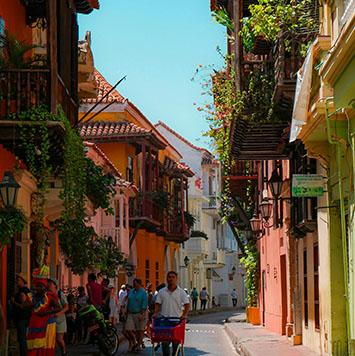
UNESCO-listed walled colonial city on Colombia's Caribbean coast — the most-visited tourism destination in the country. The Ciudad Amurallada (Walled City) for the iconic colonial center + Castillo San Felipe; Getsemaní for the bohemian + nightlife scene; Islas del Rosario for Caribbean day trips. Rafael Núñez (CTG) airport is ~15 min from the historic center. Hot + humid Caribbean climate year-round.