

Book Affordable Bus Tickets to Pasto
Andean capital of Nariño near the Ecuador border
Why choose Spring Bus?
Spring Bus is the best way to find bus tickets to Pasto

Plan your perfect trip
Find and book your bus tickets in just a few clicks.

Best prices
We partner with top bus companies to provide you with the best prices available.

Flexible Booking
Change your travel plans as needed with our flexible booking options.
Pasto sits high in the Andes of southern Colombia, the capital of the Nariño department and one of the country's most underrated cities. Founded in the sixteenth century at the foot of the still-active Galeras volcano, it is a place of cool mountain air, colonial churches and a strong, independent regional identity that owes much to its proximity to Ecuador. The city is best known worldwide for its Carnaval de Negros y Blancos, a riotous early-January festival inscribed on the UNESCO list of intangible cultural heritage, when the streets fill with elaborate floats, music and a famous tradition of dusting one another with powder and paint. Outside carnival season, Pasto rewards travellers with its handicrafts, particularly the lacquered woodwork known as barniz de Pasto, and a welcoming, down-to-earth atmosphere.
For most visitors, Pasto is both a destination and a strategic stop on the long overland journey between Colombia and Ecuador. It lies on the Pan-American Highway and serves as the base for visiting the extraordinary Las Lajas Sanctuary, a neo-Gothic basilica built into a river gorge near the border town of Ipiales. The surrounding Nariño countryside offers volcanoes, the turquoise Laguna de la Cocha and high páramo landscapes. Buses connect Pasto north toward Cali and Bogotá and south to the Ecuadorian frontier at Rumichaca, making it an essential hub for anyone crossing this part of the Andes.
Popular routes to Pasto
Estimated travel time, distance and shared-shuttle fare ranges for the most common routes into Pasto.
From Cali
- Duration
- ~8–9h
- Distance
- 385 km
- Fare (shared shuttle)
- $18–$32 USD
- Frequency
- Several daily (Bolivariano/Trans Ipiales)
From Ipiales
- Duration
- ~1.5–2h
- Distance
- 85 km
- Fare (shared shuttle)
- $4–$8 USD
- Frequency
- Frequent (Supertaxis del Sur/Trans Ipiales)
From Popayán
- Duration
- ~5–6h
- Distance
- 255 km
- Fare (shared shuttle)
- $12–$22 USD
- Frequency
- Several daily (Bolivariano)
From Bogotá
- Duration
- ~18–20h
- Distance
- 800 km
- Fare (shared shuttle)
- $35–$55 USD
- Frequency
- Daily (Bolivariano)
From Cartago
- Duration
- ~10–11h
- Distance
- 445 km
- Fare (shared shuttle)
- $22–$38 USD
- Frequency
- Daily (Trans Ipiales)
Routes from Pasto
Direct bus and shuttle service leaving Pasto for other destinations in Colombia — tap any route for travel time, fares, operators, and FAQs.
How to get to Pasto by bus
Pasto lies on the Pan-American Highway in Colombia's far south and is reached chiefly by long-distance bus along that corridor, with a small domestic airport for faster connections.
By bus from Cali
The most common overland approach to Pasto is the bus from Cali, the major city to the north, taking around eight to nine hours over 385 kilometres of winding Andean highway. Bolivariano and Trans Ipiales operate the route several times a day, with comfortable daytime and overnight services. The road follows the Pan-American Highway south through Popayán and into the steep, green folds of the Nariño mountains, a scenic but demanding drive with many curves. Fares typically range from eighteen to thirty-two US dollars depending on the company and seat class. Buses arrive at the Terminal de Transportes de Pasto on the edge of the city, from where taxis run quickly into the centre. Because the mountain road is slow and prone to delays from weather or roadworks, give yourself extra time and consider an overnight departure so you arrive rested in the morning.
By bus from Ipiales and the Ecuador border
If you are crossing from Ecuador, you will pass through the border at Rumichaca near Ipiales, the closest Colombian town to the frontier. From Ipiales, frequent buses and shared taxis run by Supertaxis del Sur and Trans Ipiales cover the 85 kilometres to Pasto in about an hour and a half to two hours. This is also the route to take for visiting the spectacular Las Lajas Sanctuary, which sits just outside Ipiales. Fares are inexpensive, only a few US dollars, and departures are frequent throughout the day.
By air
Pasto is served by Antonio Nariño Airport, located in the town of Chachagüí about 35 kilometres north of the city. It receives domestic flights from Bogotá and Cali, offering a much faster alternative to the long bus journeys, though the airport's mountain setting means flights are occasionally delayed by weather. Taxis link the airport to central Pasto in roughly 45 minutes.
About Pasto
Pasto was founded by the Spanish in 1537 and grew into the administrative and cultural heart of Nariño, the department occupying Colombia's southwestern corner against the Ecuadorian border. Sitting at around 2,500 metres above sea level on the Atriz valley, the city is dominated by the brooding cone of the Galeras volcano, one of the most active in Colombia, whose periodic rumblings are part of daily life here. The colonial centre holds a clutch of historic churches and the museums that preserve the region's distinctive crafts, above all the barniz de Pasto, a pre-Hispanic lacquering technique using resin from the mopa-mopa plant that UNESCO has recognised as cultural heritage. The people of Nariño, often called pastusos, are known across Colombia for their strong regional pride and their good humour in the face of the gentle jokes other Colombians tell about them.
The city's calendar revolves around the Carnaval de Negros y Blancos, held in the first week of January and counted among the great festivals of the Andes. Over several days the streets erupt with enormous handcrafted floats, parades, music and the playful tradition of covering strangers in talc and coloured foam, all of which earned the celebration a place on UNESCO's intangible heritage list in 2009. Beyond the carnival, Pasto anchors a region of remarkable natural beauty, from the mist-shrouded Laguna de la Cocha and its island reserve to the high páramos and, of course, the world-renowned Las Lajas Sanctuary near Ipiales. As the last major Colombian city before Ecuador, Pasto is both a cultural destination in its own right and an essential waypoint for travellers moving between the two countries.
Travel tips for getting to Pasto
- Visit during the Carnaval de Negros y Blancos in early January for the UNESCO-listed festival, but book accommodation and bus tickets well in advance as the city fills up.
- Pack warm layers, since Pasto sits at around 2,500 metres and evenings in this Andean valley are genuinely cold year-round.
- Combine Pasto with a trip to Las Lajas Sanctuary near Ipiales, an easy 85-kilometre bus ride south toward the Ecuador border.
- Take a daytime bus from Cali if scenery matters to you, as the Pan-American Highway through Nariño is winding and spectacular but slow.
- Pick up authentic barniz de Pasto crafts directly in the city, where the lacquered woodwork is far cheaper and more genuine than elsewhere.
- Allow buffer time on travel days, because the mountain roads around Pasto are prone to delays from weather, fog and roadworks.
Bus to Pasto — frequently asked questions
How long is the bus from Cali to Pasto?
The bus from Cali to Pasto takes about eight to nine hours over 385 kilometres of winding Andean highway. Bolivariano and Trans Ipiales run the route several times a day, with both daytime and overnight services available.
What is Pasto famous for?
Pasto is best known for the Carnaval de Negros y Blancos, a UNESCO-listed festival held each January, and for the traditional barniz de Pasto lacquered craft. It is also the gateway to the Las Lajas Sanctuary and a key stop near the Ecuador border.
How do I get from Pasto to Las Lajas Sanctuary?
Take a bus or shared taxi from Pasto to Ipiales, about an hour and a half to two hours away with Supertaxis del Sur or Trans Ipiales. From Ipiales, a short local ride brings you to the Las Lajas Sanctuary in its dramatic gorge setting.
Is Pasto near the Ecuador border?
Yes, Pasto is the last major Colombian city before Ecuador. The Rumichaca border crossing near Ipiales is about 85 kilometres south, reachable in roughly an hour and a half to two hours by frequent buses and shared taxis.
Does Pasto have an airport?
Yes, Antonio Nariño Airport is located in Chachagüí about 35 kilometres north of Pasto and receives domestic flights from Bogotá and Cali. Its mountain location means flights are occasionally delayed by weather.
Other destinations in Colombia
 Destination
Bogotá
Cundinamarca (Andes, 2,640 m)
Colombia's capital at 2,640 m altitude — cool year-round (10–20°C). El Dorado International Airport (BOG) is South America's major hub for Avianca, Copa, LATAM, and US carriers. La Candelaria colonial district, Monserrate hilltop, the Gold Museum, and TransMilenio BRT. Most long-distance trips within Colombia are flown, not bussed — distances are vast (Bogotá-Medellín ~9 h by Pullman, ~1 h by flight).
DestinationMedellín
Antioquia (Andes, 1,500 m)
Colombia's second city — "City of Eternal Spring" at 1,500 m altitude, comfortable climate year-round (18–28°C). Famous for the Metrocable cable cars that ride up to former hillside slums (Colombia's only metro system, opened 1995), Comuna 13 graffiti tour, Pueblito Paisa hilltop, and the major remote-worker hub status. José María Córdova (MDE) airport ~30 min east via tunnel.
DestinationCartagena
Bolívar (Caribbean coast)
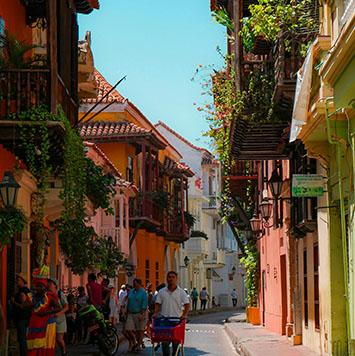
UNESCO-listed walled colonial city on Colombia's Caribbean coast — the most-visited tourism destination in the country. The Ciudad Amurallada (Walled City) for the iconic colonial center + Castillo San Felipe; Getsemaní for the bohemian + nightlife scene; Islas del Rosario for Caribbean day trips. Rafael Núñez (CTG) airport is ~15 min from the historic center. Hot + humid Caribbean climate year-round.