

Book Affordable Bus Tickets to Salento
The painted pueblo at the doorstep of Colombia's wax palms
Why choose Spring Bus?
Spring Bus is the best way to find bus tickets to Salento

Plan your perfect trip
Find and book your bus tickets in just a few clicks.

Best prices
We partner with top bus companies to provide you with the best prices available.

Flexible Booking
Change your travel plans as needed with our flexible booking options.
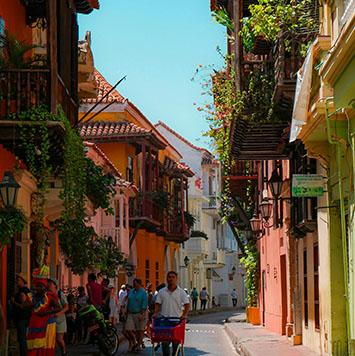
Salento sits in the hills of Quindío at roughly 1,900 meters, a compact pueblo whose reputation far outsizes its few thousand residents. The main drag, Calle Real, is a corridor of saturated facades, hand-painted doors and craft stalls that funnels uphill to the Mirador Alto de la Cruz, where a short staircase opens onto a panorama of the Cocora Valley. Mornings are cool and clear, afternoons cloud over fast, and the whole town runs on a relaxed rhythm built around coffee, walking and the constant shuttle of Jeeps to the trailheads. It is the natural first stop for anyone exploring the Eje Cafetero on foot.
Most visitors base themselves here for two or three nights and treat the town as a launchpad. The headline excursion is the Cocora Valley, home to the towering wax palm, Colombia's national tree and the tallest palm on earth. Closer in, working fincas open their doors for tastings and tours, and the surrounding hills are laced with quiet trails. Salento is small enough to cross in fifteen minutes yet busy enough that weekends and holidays bring crowds, so an early start always pays off.
Popular routes to Salento
Estimated travel time, distance and shared-shuttle fare ranges for the most common routes into Salento.
From Armenia
- Duration
- ~45 min
- Distance
- 25 km
- Fare (shared shuttle)
- $2–$5 USD
- Frequency
- Frequent minibus/willy
From Pereira
- Duration
- ~1 hr
- Distance
- 50 km
- Fare (shared shuttle)
- $3–$6 USD
- Frequency
- Several daily
From Medellín
- Duration
- ~6 hrs
- Distance
- 300 km
- Fare (shared shuttle)
- $18–$28 USD
- Frequency
- Several daily (via Armenia)
From Bogotá
- Duration
- ~8 hrs
- Distance
- 290 km
- Fare (shared shuttle)
- $20–$32 USD
- Frequency
- Several daily (via Armenia)
From Cali
- Duration
- ~4 hrs
- Distance
- 200 km
- Fare (shared shuttle)
- $12–$20 USD
- Frequency
- Several daily (via Armenia)
Routes from Salento
Direct bus and shuttle service leaving Salento for other destinations in Colombia — tap any route for travel time, fares, operators, and FAQs.
How to get to Salento by bus
Salento has no large bus terminal of its own, so almost everyone arrives through Armenia or Pereira and finishes the trip on a short regional connection. Both gateways are simple to reach from the rest of Colombia.
By bus from Armenia
Armenia is the closest and easiest gateway. From the Terminal de Transportes de Armenia, minibuses and the company Cootracir run to Salento roughly every 20 to 40 minutes during the day, taking about 45 minutes for the 25-kilometer climb and costing only a couple of dollars. They drop you on or near Salento's main plaza. If you are coming from Bogotá, Medellín, Cali or the coast, the cleanest plan is to ride a long-distance coach to Armenia first, then transfer. Buses thin out in the evening, so aim to reach Armenia before nightfall to be sure of a same-day onward connection up to Salento.
By bus from Pereira
Pereira is the region's other main hub and home to Matecaña airport. Direct buses run from Pereira's terminal to Salento several times a day, taking around an hour for the 50-kilometer trip and costing a few dollars. This route suits travelers flying into Pereira or arriving from Medellín, since the highway from Antioquia passes nearby. Service is less frequent than from Armenia, so check the last departure if you land in the afternoon, and consider routing through Armenia as a backup if the timing is tight.
By Jeep Willys
The classic local ride is the Willys, a vintage Jeep that shuttles between Salento's plaza and the Cocora Valley trailheads. They leave when full from early morning, take about 30 minutes each way and cost a couple of dollars. Riders sometimes hang off the back rail for the photo. These same Jeeps also reach nearby farms and viewpoints, making them the standard way to get around once you have arrived in town.
About Salento
Salento was founded in 1842 and is among the oldest towns in Quindío, predating much of the coffee colonization that shaped the surrounding department. Its grid of low houses with deep eaves and brightly painted woodwork is a textbook example of the regional bahareque style, built to shed heavy rain and tremors alike. That architecture, together with the working coffee landscape around it, is part of why UNESCO inscribed the Coffee Cultural Landscape of Colombia as a World Heritage site in 2011. Walking Calle Real today, you pass coffee shops roasting local beans, artisan stalls selling woven goods and leather, and balconies that have become some of the most recognizable images of rural Colombia.
Beyond the photogenic center, Salento's identity is tied to two things: the bean and the valley. Small family fincas in the hills offer hands-on tours where you pick, pulp, dry and finally taste coffee grown on the same slope, a far more intimate experience than the big themed attractions elsewhere in the region. Just up the road, the Cocora Valley delivers the surreal sight of 60-meter wax palms rising from emerald pasture, walkable on loop trails that climb into cloud forest. Add the local obsession with tejo, the explosive gunpowder lawn game played in bars across town, and Salento becomes a place that rewards slowing down rather than rushing through.
Travel tips for getting to Salento
- Go to Cocora early. Catch one of the first Willys Jeeps from the plaza around 7 to 8 am to beat both the crowds and the midday cloud that rolls in over the valley.
- Carry small cash. Many fincas, Willys drivers and craft stalls prefer pesos in small notes, and ATMs in town are few and can run dry on busy weekends.
- Pack for rain and mud. The coffee zone is wet year-round; bring a light rain jacket and shoes you do not mind dirtying for the Cocora loop.
- Book ahead on holidays. Salento fills up during Colombian long weekends and the December to January season, so reserve a room and your onward bus in advance.
- Choose a small finca tour. Family-run farms like El Ocaso or finca Don Elías give a deeper, more personal coffee experience than the larger commercial parks.
- Use Armenia as your transfer hub. It has the most frequent connections to Salento, so route long-distance coaches through Armenia for the smoothest arrival.
Bus to Salento — frequently asked questions
How do I get to Salento by bus?
There is no direct long-distance terminal in Salento itself. Travelers ride to Armenia or Pereira on a long-haul coach, then take a short regional minibus the rest of the way. From Armenia it is about 45 minutes and runs every 20 to 40 minutes; from Pereira it is about an hour with several departures a day.
How long is the bus from Armenia to Salento?
The trip from Armenia's terminal to Salento takes roughly 45 minutes to cover the 25 kilometers of winding road, and costs only a few dollars. Minibuses leave frequently throughout the day until early evening.
Can I reach Salento directly from Bogotá or Medellín?
Some companies advertise through-service, but in practice most journeys involve changing in Armenia. Plan on roughly 8 hours from Bogotá and 6 hours from Medellín, then a short connection up to Salento.
How do I get from Salento to the Cocora Valley?
Vintage Willys Jeeps shuttle from Salento's main plaza to the Cocora trailheads in about 30 minutes for a couple of dollars. They depart when full starting early in the morning, so arrive ahead of the crowds.
How many days should I spend in Salento?
Two to three nights is ideal. That gives you a full day for the Cocora Valley hike, a half day for a coffee-farm tour, and time to wander Calle Real and the viewpoint without rushing.
Other destinations in Colombia
 Destination
Bogotá
Cundinamarca (Andes, 2,640 m)
Colombia's capital at 2,640 m altitude — cool year-round (10–20°C). El Dorado International Airport (BOG) is South America's major hub for Avianca, Copa, LATAM, and US carriers. La Candelaria colonial district, Monserrate hilltop, the Gold Museum, and TransMilenio BRT. Most long-distance trips within Colombia are flown, not bussed — distances are vast (Bogotá-Medellín ~9 h by Pullman, ~1 h by flight).
DestinationMedellín
Antioquia (Andes, 1,500 m)
Colombia's second city — "City of Eternal Spring" at 1,500 m altitude, comfortable climate year-round (18–28°C). Famous for the Metrocable cable cars that ride up to former hillside slums (Colombia's only metro system, opened 1995), Comuna 13 graffiti tour, Pueblito Paisa hilltop, and the major remote-worker hub status. José María Córdova (MDE) airport ~30 min east via tunnel.
DestinationCartagena
Bolívar (Caribbean coast)
UNESCO-listed walled colonial city on Colombia's Caribbean coast — the most-visited tourism destination in the country. The Ciudad Amurallada (Walled City) for the iconic colonial center + Castillo San Felipe; Getsemaní for the bohemian + nightlife scene; Islas del Rosario for Caribbean day trips. Rafael Núñez (CTG) airport is ~15 min from the historic center. Hot + humid Caribbean climate year-round.